Creative Biolabs is offering the most comprehensive services for antibody development projects. With strict regulation and effective execution, we are dedicated to providing the most valuable solutions to complete your projects.
HighlightsCreative Biolabs is offering the most comprehensive services for antibody development projects. With strict regulation and effective execution, we are dedicated to providing the most valuable solutions to complete your projects.
HighlightsCreative Biolabs has established a broad range of platforms for developing novel antibodies or equivalents. These cutting-edge technologies enable our scientists to meet your demands from different aspects and tailor the most appropriate solution that contributes to the success of your projects.
HighlightsWith deep understanding in antibody-related realms and extensive project experience, Creative Biolabs offers a variety of references to help you learn more about our capacities and achievements, including infographic, flyer, case study, peer-reviewed publications, and all kinds of knowledge that can assist your projects. You are also welcome to contact us directly for more specific solutions.
HighlightsGet a real taste of Creative Biolabs, one of the most professional custom service providers in the world. We are committed to providing highly customized comprehensive solutions with the best quality to advance your projects.
HighlightsIn the landscape of biotherapeutics and advanced diagnostics, antibody stability is not just a desirable attribute; it is the cornerstone of efficacy, safety, and commercial viability. An antibody with suboptimal stability can suffer from aggregation, denaturation, fragmentation, or loss of function, leading to reduced shelf-life, poor in vivo pharmacokinetics, and potential immunogenicity. With over two decades of dedicated expertise in antibody engineering, Creative Biolabs offers a comprehensive suite of Antibody Stability Improvement services. We deploy a sophisticated, multi-pronged strategy that integrates advanced computational biology, state-of-the-art directed evolution platforms, and precision rational protein design. Our goal is to meticulously re-engineer your antibody candidates—be it full-length IgGs, scFvs, Fabs, or single-domain antibodies (SdAbs)—to achieve superior thermal, chemical, and physical robustness without compromising their critical binding affinity or specificity.
Antibody instability is a multifaceted problem that can manifest at any stage, from manufacturing and purification to long-term storage and administration. A successful stability improvement strategy must address all three pillars of protein stability.
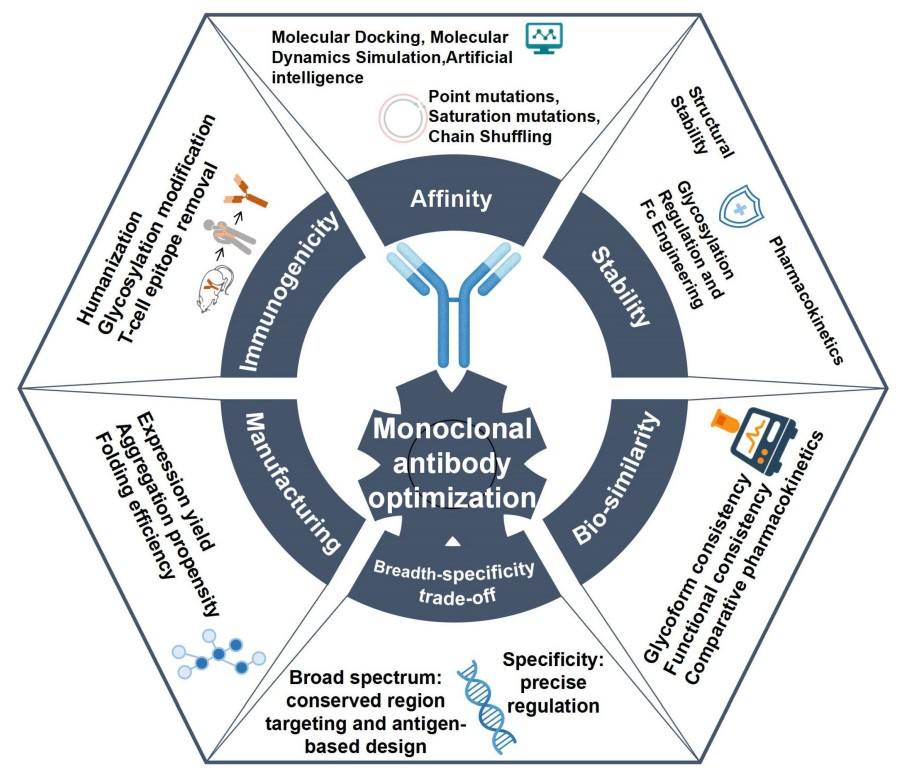 Fig. 1 Schematic illustration of monoclonal antibody optimization.1
Creative Biolabs rejects a "one-size-fits-all" approach. We tailor our engineering strategy to your specific antibody format, target, and development goals. Our platform is a powerful synergy of in silico prediction, high-throughput screening, and rational engineering.
Our workflow begins with a deep computational analysis to build a predictive model of your antibody's weaknesses. This "developability assessment" identifies liabilities before they become experimental problems.
For complex stability issues or when affinity must be simultaneously improved, rational design is complemented by directed evolution. We create vast mutant libraries and apply powerful selection pressures to isolate clones with elite stability profiles.
In some cases, stability can be dramatically enhanced through bioconjugation or formulation engineering.
Engineering a stable antibody is only half the battle. You must prove it. Creative Biolabs provides a state-of-the-art analytical core to validate the success of our antibody stability improvement efforts and provide you with a comprehensive data package.
We characterize all three forms of stability using orthogonal, high-resolution methods.
We determine the intrinsic thermal robustness of your engineered antibody.
We assess how your antibody behaves in solution, especially at high concentrations.
We subject your antibody to harsh conditions to predict its long-term stability and identify degradation pathways.
To further support your antibody engineering pipeline, Creative Biolabs offers a full spectrum of related services.
Don't let antibody stability be the weak link in your development chain. Contact the experts at Creative Biolabs today. Our team is ready to discuss your project and design a custom antibody stability improvement strategy to enhance the performance and viability of your candidate.
Q: What is the typical "fold improvement" in stability you can achieve?
A: This is highly dependent on the starting antibody and its specific liabilities. For thermal stability, it is common to see an improvement in the melting temperature (Tm) of 5-10°C. For chemical stability, we aim to remove >90% of a critical liability like deamidation. We will set a clear project goal with you based on your antibody's initial profile.
Q: Will the antibody stability improvement process affect my antibody's affinity?
A: This is a critical consideration. Our strategies are explicitly designed to preserve affinity. For example, in our directed evolution platforms (yeast/CHO display), we co-select for both stability (e.g., thermal challenge) and high-affinity antigen binding (e.g., sorting for strong fluorescent signal). For rational design, we computationally model mutations to ensure they do not disrupt the CDR-antigen interface.
Q: How do you decide which strategy (rational design vs. directed evolution) to use?
A: The choice depends on your antibody and your goals. If in silico analysis reveals a few clear, high-risk chemical liability hotspots (like an Asn-Gly sequence in a CDR), a fast and precise rational design approach is often best. If the antibody suffers from general, poor conformational stability (low Tm) without obvious "smoking gun" hotspots, a directed evolution approach is more powerful as it can screen billions of mutations to find novel stabilizing solutions.
Q: What antibody formats can you work with for stability improvement?
A: Our platforms are highly flexible. We routinely perform antibody stability improvement on full-length IgGs, scFvs, Fabs, bispecific antibodies, and single-domain antibodies. Our mammalian display systems are particularly well-suited for complex, glycosylated, full-length formats.
All listed services and products are For Research Use Only. Do Not use in any diagnostic or therapeutic applications.